
The federal government has enacted the Alternative Dispute Resolution (Amendment) Act, 2026, introducing significant reforms to the Alternative Dispute Resolution Act, 2017 by making Alternative Dispute Resolution (ADR) mandatory for specified categories of disputes. The new law has come into force with immediate effect following its passage.
Under the amendment, a new Section 3A has been inserted, making it compulsory for courts to refer all matters listed in Schedule-II to ADR. This marks a major departure from the previous framework, where courts had discretion in referring cases to mediation, conciliation, or arbitration. Now, for the subject matters covered under Schedule-II, courts are legally bound to initiate ADR before proceeding with formal litigation.
The law further clarifies that the disputes falling under Schedule-II—primarily civil, commercial, financial, and family-related matters—will compulsorily be referred to ADR mechanisms for resolution. These are categories of disputes considered suitable for settlement outside court through negotiation and mediation, ensuring quicker and less adversarial outcomes. This provision is aimed at ensuring that such matters are resolved expeditiously without burdening the courts.
As part of the amendment, the existing Schedule has been redesignated as Schedule-I, while the newly added Schedule-II contains the list of disputes subject to mandatory ADR. This structural change ensures clarity in classification and implementation of the law.
Another important insertion is Section 25A, which grants the federal government the authority to amend the schedules in consultation with the Islamabad High Court through official notification. This enables the government to update or expand the scope of ADR without requiring further legislative amendments, making the system more flexible and responsive.
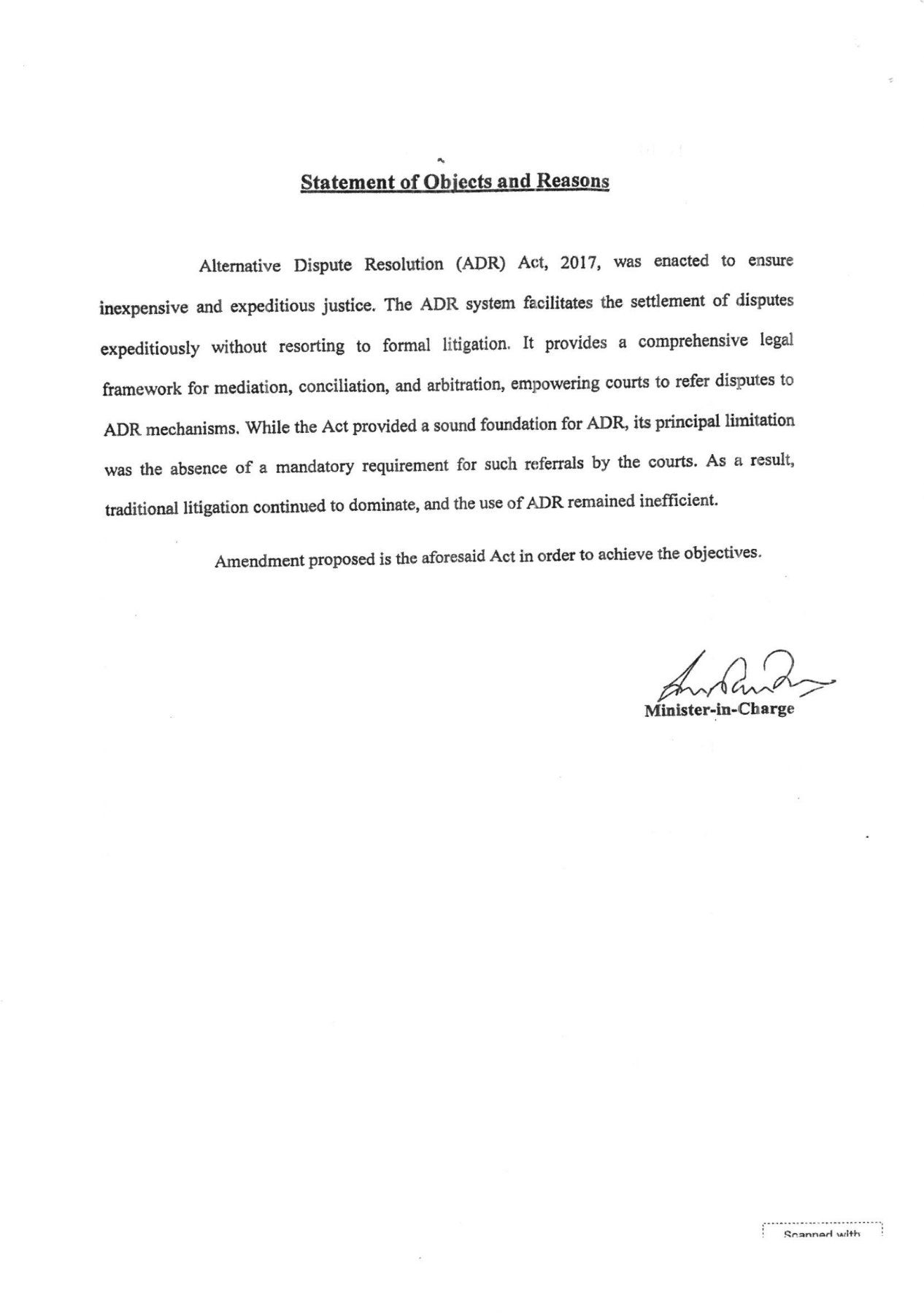
The amendment addresses a longstanding limitation of the 2017 Act, which, despite providing a comprehensive ADR framework, lacked a mandatory referral mechanism. As a result, ADR remained underutilized, and traditional litigation continued to dominate the justice system.
The impact of this new law is expected to be far-reaching. By mandating ADR in specified matters, it will likely reduce case backlog in courts, promote cost-effective and speedy dispute resolution, and encourage a shift toward amicable settlements. Legal experts believe that this reform will strengthen the efficiency of the justice system and provide litigants with faster and more accessible remedies.
Overall, the enactment of the amendment represents a significant step toward modernizing dispute resolution in Pakistan by embedding ADR as a central component of the legal process.
