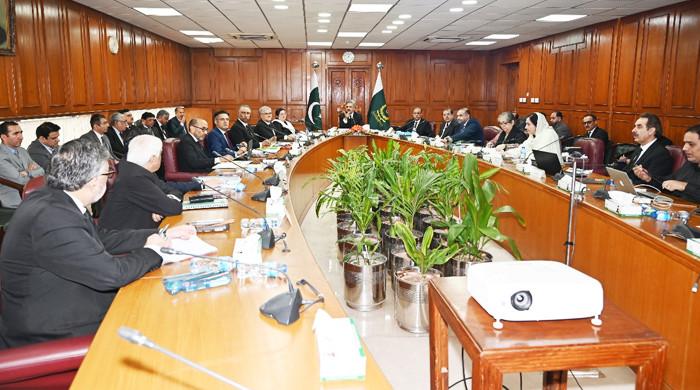
March 26, 2026– In a significant development challenging the recent reduction in court working days, a senior advocate has formally approached the National Judicial (Policy Making) Committee (NJPMC) and all High Courts, urging an immediate restoration of the five-day work week for superior courts and a six-day schedule for the subordinate judiciary.
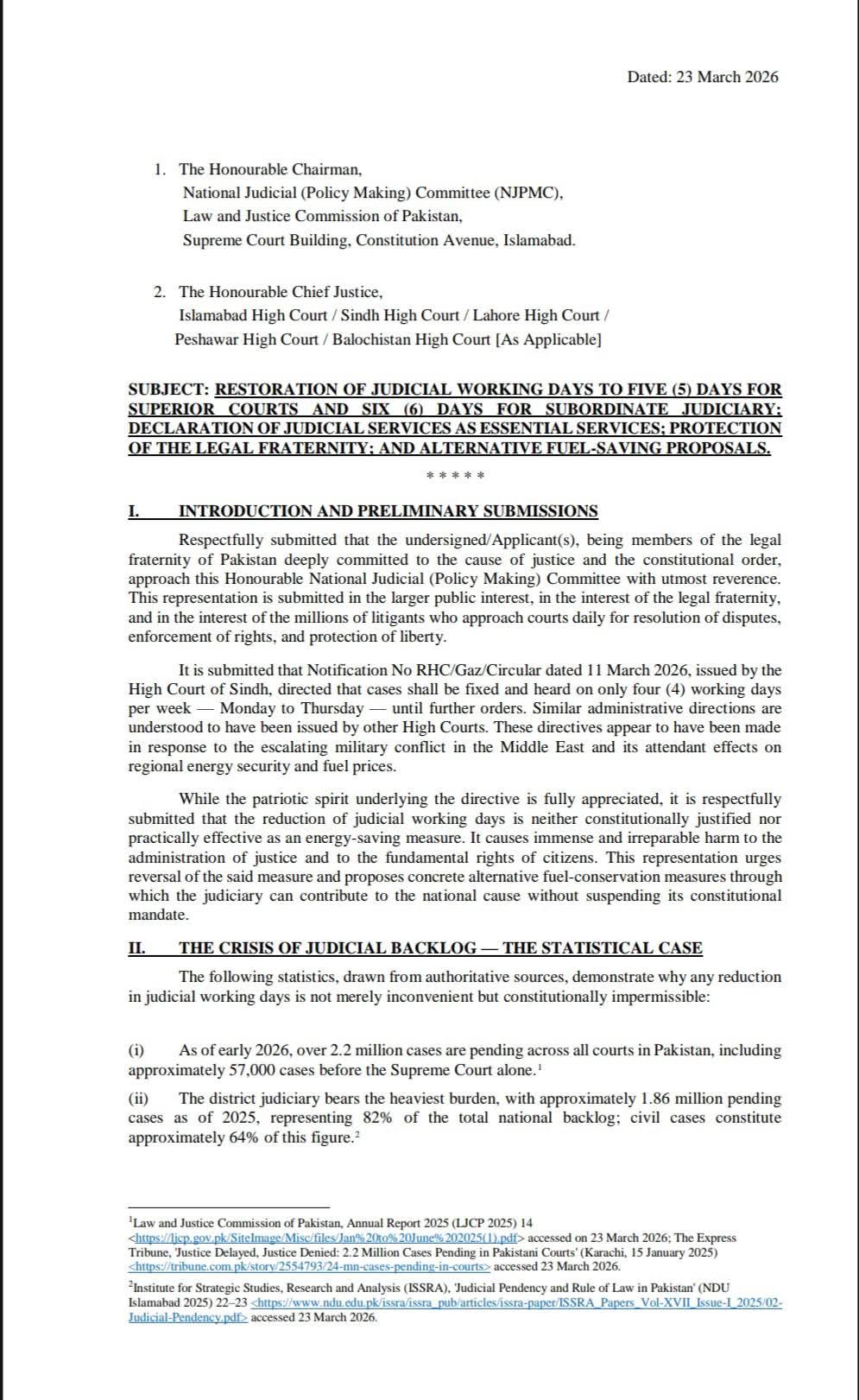
The representation has been filed by Ghulam Asghar Pathan, an Advocate of the Supreme Court of Pakistan, who has invoked the powers of the NJPMC to intervene against administrative directives, most notably Notification No RHC/Gaz/Circular dated 11 March 2026 issued by the High Court of Sindh. It is understood that similar directives have been issued by other High Courts across the country.
The impugned circulars, ostensibly issued in response to the escalating military conflict in the Middle East and resulting energy security concerns, have reduced the working week to only four days (Monday to Thursday). In his representation, Advocate Pathan argues that while the patriotic intent behind the measure is appreciated, the curtailment of judicial working days is “neither constitutionally justified nor practically effective as an energy-saving measure,” causing “immense and irreparable harm” to the administration of justice and the fundamental rights of citizens.
The representation details the crippling impact of the move, highlighting that Pakistan’s courts are already grappling with a staggering backlog of over 2.2 million pending cases. Citing the Law and Justice Commission of Pakistan, the plea notes that the district judiciary bears the brunt with 1.86 million pending cases, constituting 82% of the national backlog. It warns that any reduction in working days will “exponentially worsen this pre-existing crisis,” condemning cases to “prolonged limbo.”
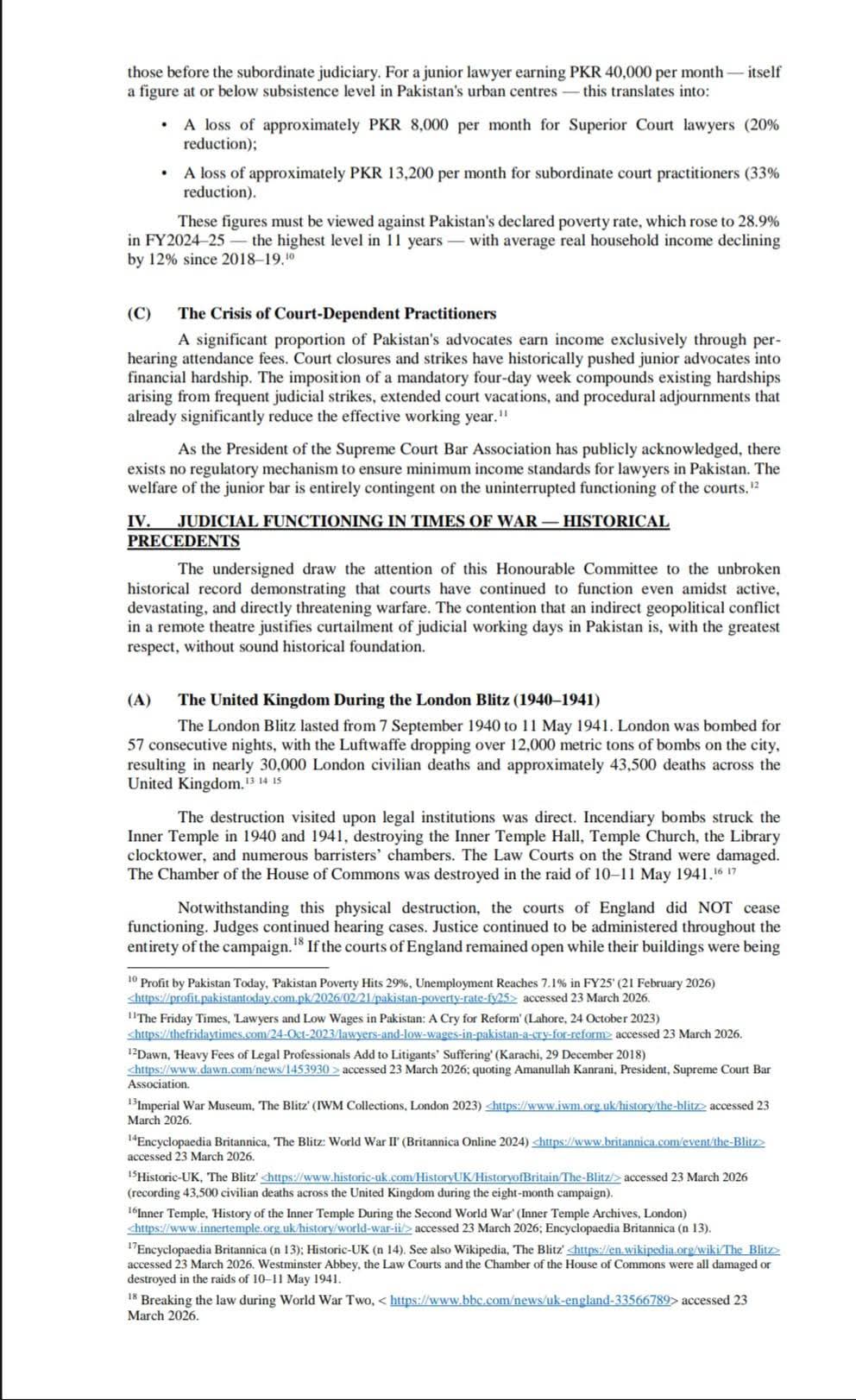
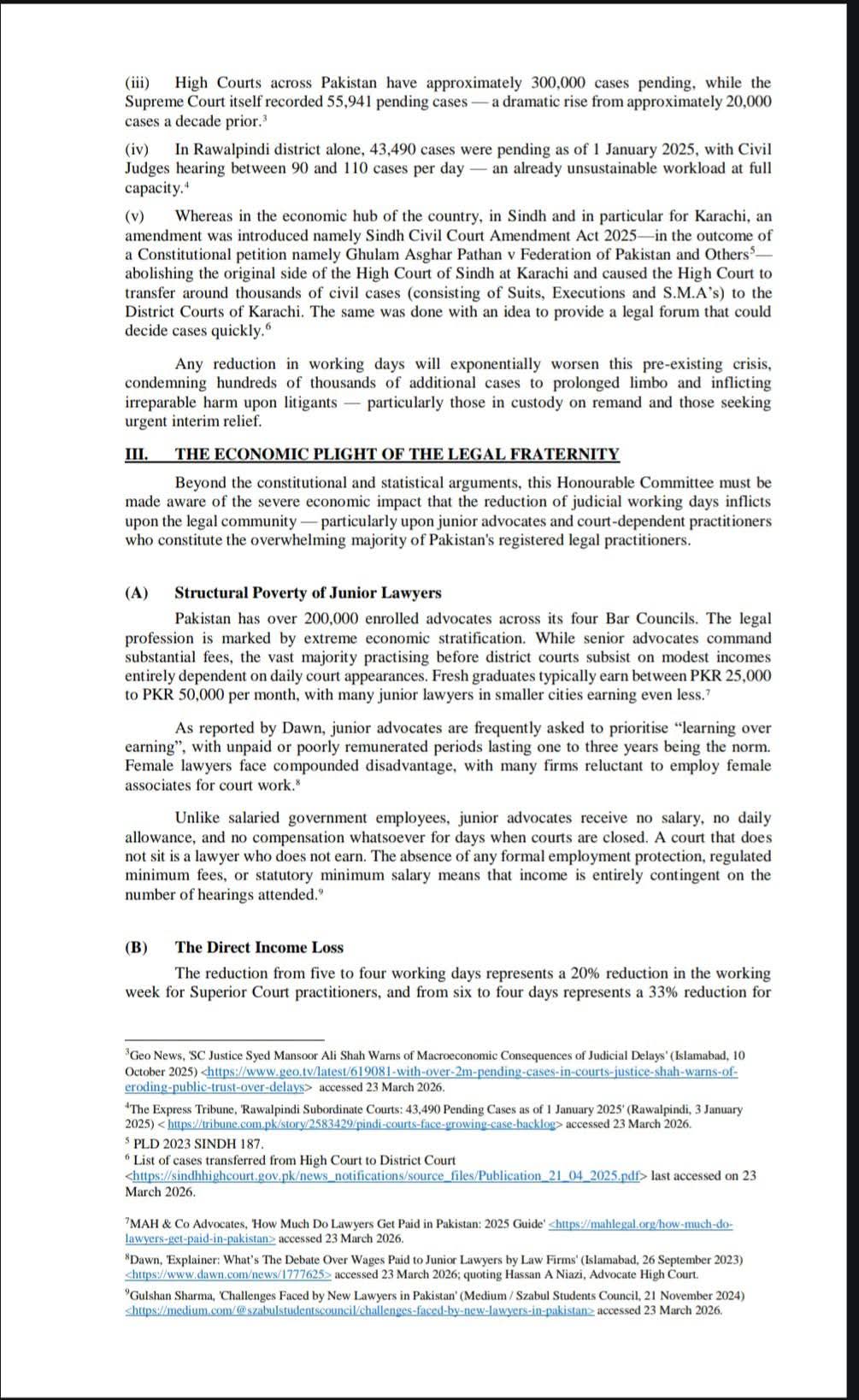
Beyond the constitutional and statistical arguments, the advocate has laid out the severe economic plight of the legal fraternity, particularly junior lawyers. The representation notes that Pakistan has over 200,000 enrolled advocates, many of whom are court-dependent practitioners with modest incomes. The reduction from five to four days (a 20% cut) for superior court practitioners, and from six to four days (a 33% cut) for subordinate court practitioners, translates directly into income loss for lawyers who receive no salary when courts are closed. The plea argues that for a junior lawyer earning near the subsistence level, this loss is catastrophic.
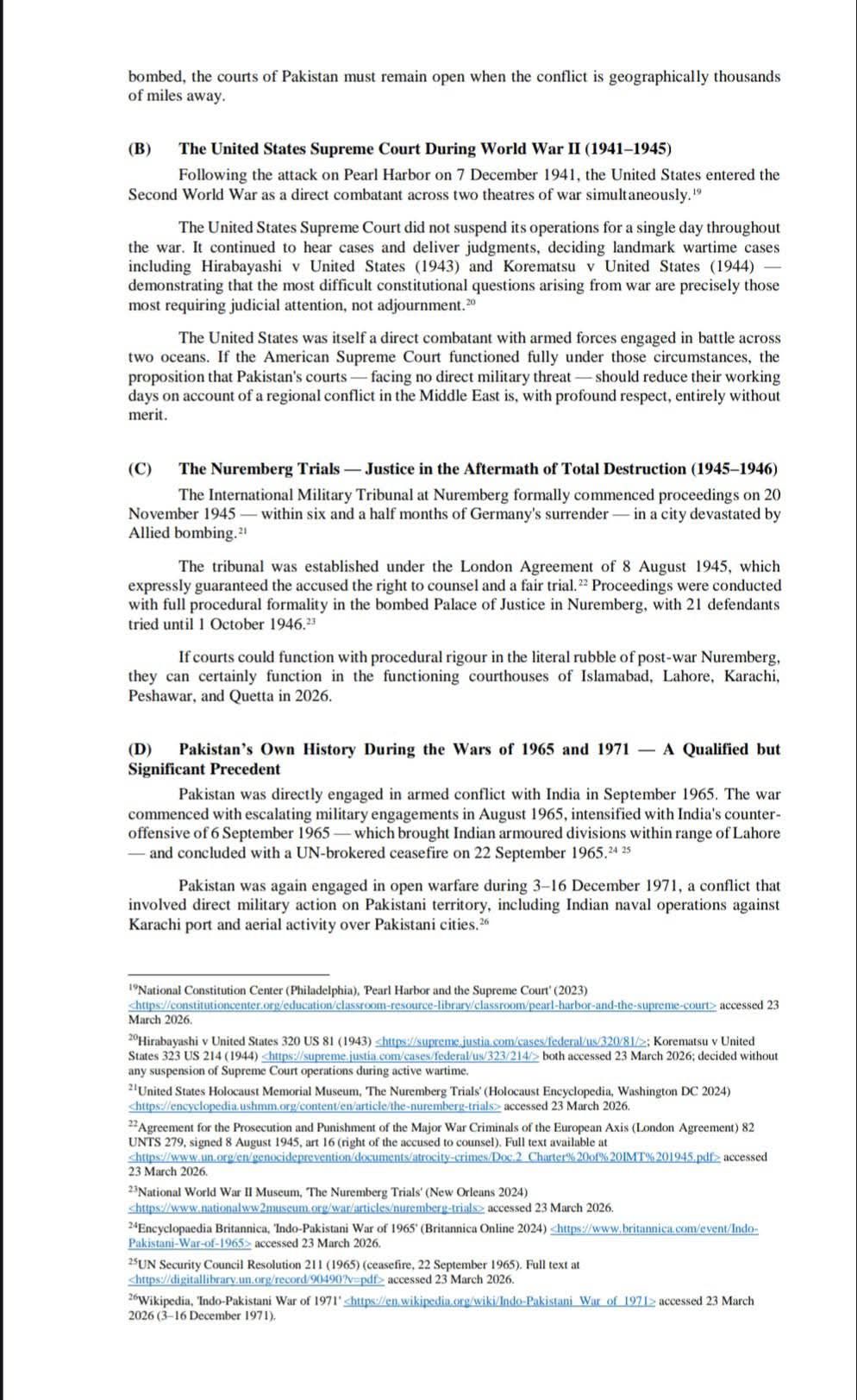
In a striking section of the representation, Advocate Pathan draws upon historical precedents to argue that courts have historically remained open during times of far greater national peril. The plea cites the example of the United Kingdom’s judiciary, which continued functioning throughout the London Blitz of 1940–41, even as bombs destroyed the Inner Temple and the Law Courts. Similarly, it notes that the United States Supreme Court did not suspend operations for a single day following the attack on Pearl Harbor or throughout World War II. The representation emphasizes that if courts remained open while their buildings were being bombed in London, or while America was a direct combatant in a world war, Pakistan’s courts must remain open for a conflict that is geographically remote.
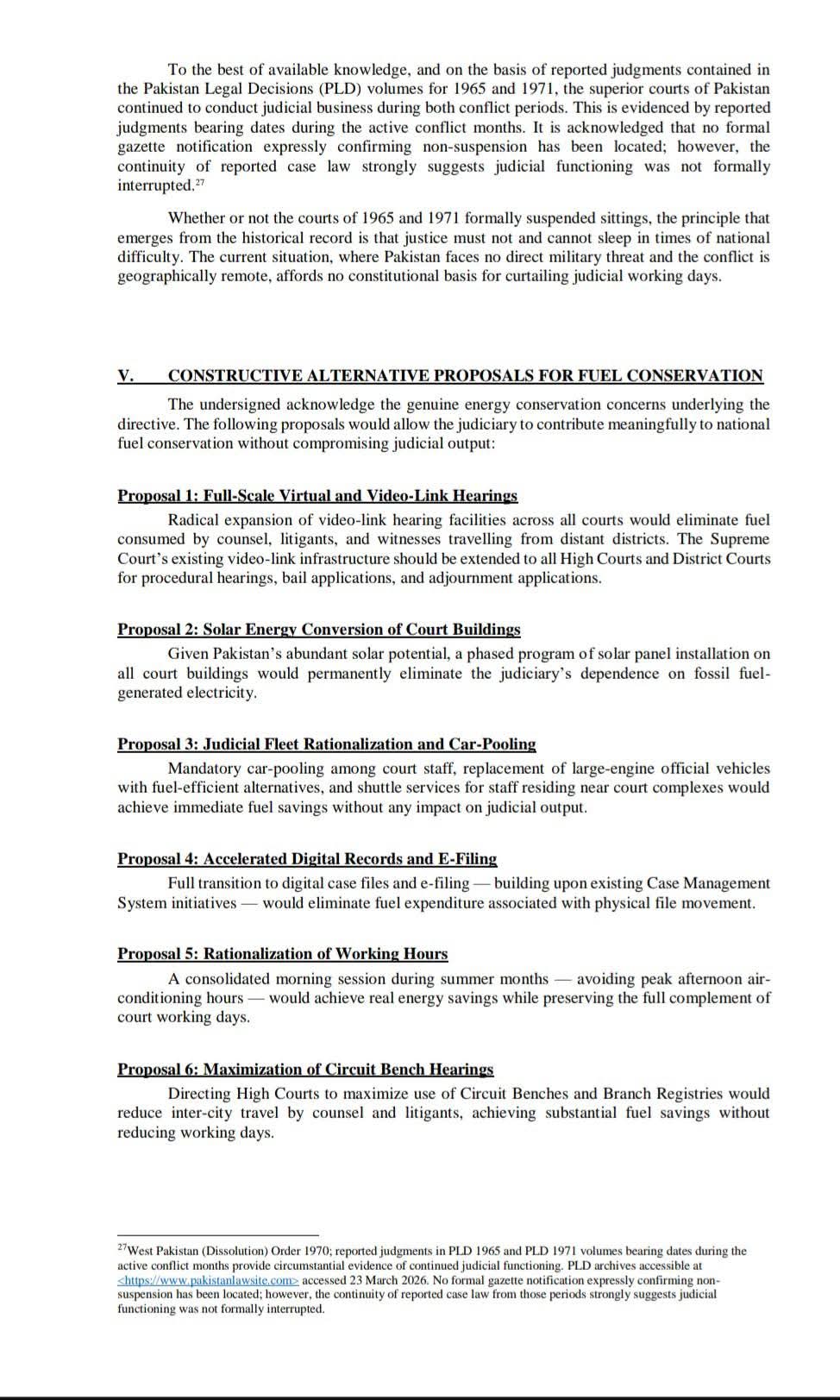
Rather than simply opposing the energy-saving measure, the advocate has put forth a comprehensive list of alternative proposals for fuel conservation within the judiciary. These include a radical expansion of video-link hearings, the installation of solar panels on court buildings, the rationalization of working hours to avoid peak energy usage, and the full implementation of e-filing and digital records.
In his concluding submissions, Advocate Pathan has urged the NJPMC to immediately withdraw the impugned notifications and issue a formal policy declaration that judicial services are “essential services” of the state, which shall not be curtailed in response to external geopolitical events.
The representation concludes with a powerful principle of constitutional continuity: “The Courts cannot be shut because the nation is at war; rather it is in times of war that the courts must be most vigilantly open.” The matter is now expected to be taken up by the National Judicial (Policy Making) Committee in its forthcoming sessions.
