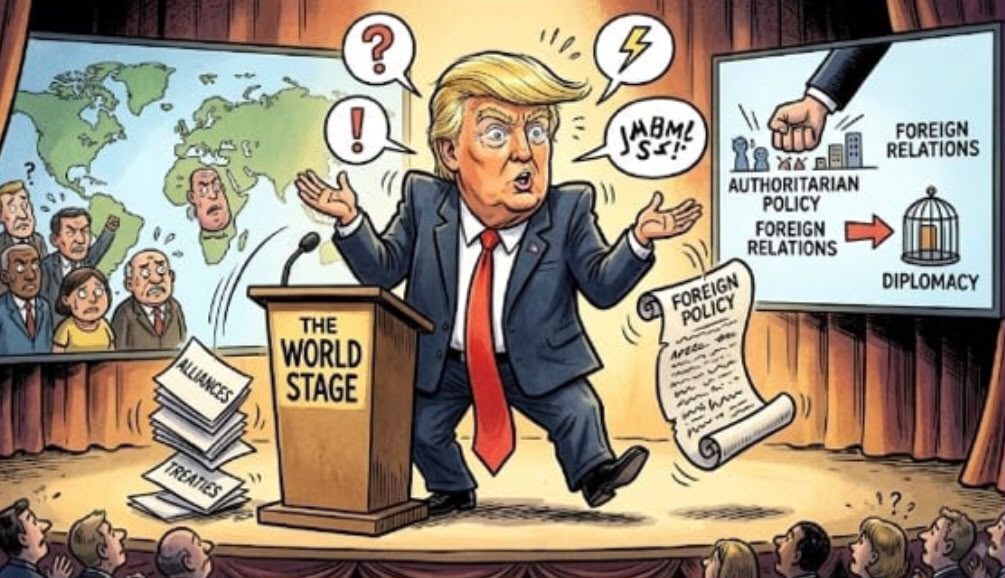
The United States of America has long remained a principal architect of the international order, making its foreign policy a decisive force in shaping global peace, security, and economic stability. However, the international system is increasingly defined by great-power rivalry, regional conflicts, economic competition, and emerging geopolitical challenges. From the war in Ukraine and instability in the Middle East to growing tensions in the Indo-Pacific, the global order is becoming more complex and fragmented. Despite these challenges, U.S. foreign policy has evolved significantly. This blog examines the transformation of U.S. foreign policy from its post-9/11 focus on counterterrorism toward strategic competition with major powers, while simultaneously addressing multiple global crises.
The world order is currently undergoing a major transformation driven by great-power rivalry, regional conflicts, economic competition, and technological change. Under Donald Trump’s administration, U.S. foreign policy has increasingly emphasized an “America First” approach, with greater attention to protectionism, reindustrialization, supply-chain restructuring, and strategic competition with China. Washington has also sought to reinforce its influence in the Western Hemisphere while encouraging allies to assume greater responsibility for regional security. This approach allows the United States to concentrate more of its strategic resources on managing China’s growing influence.
At the same time, emerging institutions reflect increasing competition over the future rules of global governance. Organizations and initiatives such as BRICS and the New Development Bank have promoted greater financial cooperation among emerging economies and encouraged discussions about reducing dependence on the U.S. dollar through increased use of local currencies. Consequently, China has become a central priority of U.S. foreign policy, replacing much of the post-9/11 emphasis on counterterrorism. The United States is also focusing on strengthening domestic governance, economic competitiveness, education, and technological development to maintain its global leadership. Furthermore, Washington has increasingly emphasized diplomacy and negotiations, combining diplomatic engagement with economic and strategic leverage rather than relying primarily on military force or sanctions.
The U.S.-China relationship represents one of the most important dimensions of this changing global order. A high-level U.S. presidential visit to China would have major implications for the global economy, technology, international conflicts, oil prices, and financial markets. Such a visit can carry significant diplomatic symbolism, particularly when accompanied by ceremonial honors and carefully planned public events. Yet the relationship remains highly competitive because of the trade war, advanced AI-chip restrictions, tensions over Taiwan, conflicts involving Iran, and the broader economic rivalry between the two countries. Despite these tensions, the United States remains a major global power. However, permanent confrontation is difficult to sustain because American voters are ultimately concerned with how foreign policy affects their lives at home.
The relationship between Washington and Beijing therefore represents a form of controlled competition. Both powers seek to protect their national interests while attempting to avoid actions that could cause severe economic or strategic damage to themselves. Technology has also become a major instrument of geopolitical power, particularly through competition over artificial intelligence, semiconductors, telecommunications, and advanced industries. The challenge for both countries is to manage this competition without allowing it to develop into a broader confrontation.
When it comes to Russia, the Trump administration has shown a greater willingness to consider normalizing relations compared with the previous approach. Russia has re-emerged as an important center of geopolitical power, while the United States had previously provided strong support to Ukraine. Trump’s approach has emphasized ending or reducing U.S. involvement in the Russia-Ukraine conflict and prioritizing economic stability and domestic interests. His statement that the United States is separated from the conflict by an ocean reflects his broader argument that Washington should avoid becoming permanently involved in distant wars. This approach demonstrates the unpredictable and rapidly changing nature of Trump’s foreign-policy priorities.
U.S. policy toward Iran also demonstrates the complexities of American foreign relations. After decades of confrontation, sanctions, and military pressure, Washington has struggled to achieve a stable long-term outcome. Israel remains one of the United States’ strongest allies in the Middle East, and its security concerns have significantly influenced American policy toward Iran. Support for Israel, regional security considerations, domestic political pressures, and lobbying have all contributed to the United States’ approach to the conflict.
Recent tensions have highlighted the potential costs of direct confrontation with Iran, including military pressure, disruption of energy supplies, risks surrounding the Strait of Hormuz, rising energy prices, and growing domestic opposition. Any major conflict with Iran could also have wider geopolitical consequences because Iran maintains important relationships with countries such as China and Russia and has strategic ties with North Korea. Therefore, U.S. foreign policy must balance military power with diplomacy, economic interests, domestic priorities, and the broader consequences of escalation.
Overall, U.S. foreign policy is moving through a period of significant transformation. The post-9/11 emphasis on counterterrorism is increasingly being replaced by strategic competition, economic security, technological rivalry, and great-power politics. The central challenge for Washington is to maintain global leadership . However, in order to maintain the “America First” policy , Trump’s foreign policy has increasingly became more authoritarian , ranging from violations of national sovereignty to the imposition of high tariffs.
