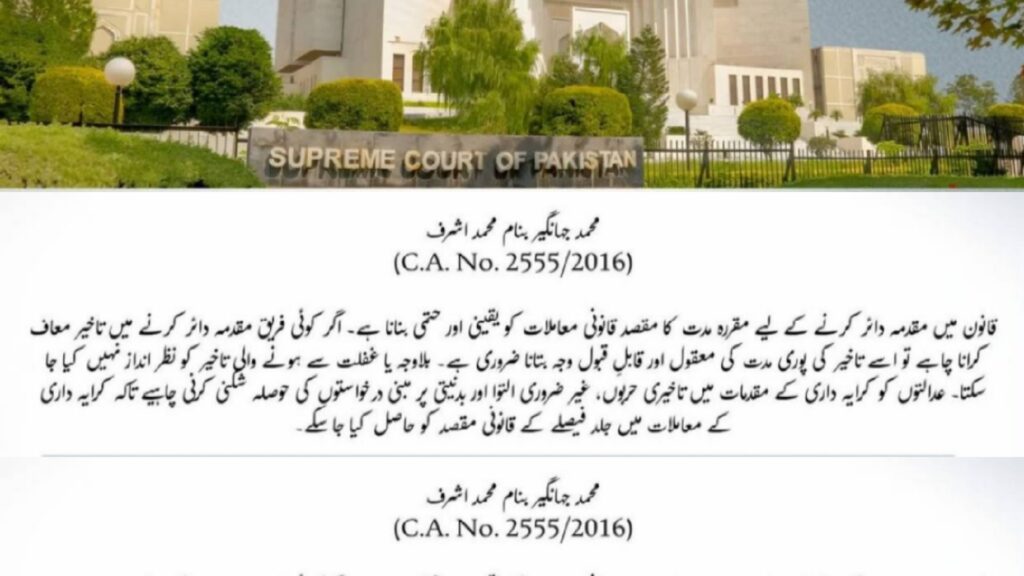
ISLAMABAD – The Supreme Court of Pakistan, through the Law and Justice Commission, has released a public awareness digest highlighting three significant rulings aimed at streamlining civil litigation and clarifying property laws. The decisions address the condonation of delays in filing suits and the strict legal requirements for exercising the right of pre-emption (Shuf’a).
Strict Criteria for Condoning Delays
In the case of Muhammad Jahangir vs. Muhammad Ashraf (C.A. No. 2555/2016), the Court ruled that the primary objective of limitation periods is to ensure swift and final resolution of legal disputes. The bench held that a party seeking to condone a delay must provide a reasonable and acceptable justification for the entire period of delay. The Court emphasized that delays attributed to employment or safety concerns cannot be casually ignored. It further warned lower courts against tolerating negligence, unnecessary adjournments, and malafide intentions, stating that doing so defeats the legal purpose of timely justice.
Strict Compliance for Right of Pre-Emption
In Altaf Hussain vs. Muhammad Zaman (C.A. No. 1543/2019), the Court underscored that the right of pre-emption is a “valuable right” that can only be exercised with complete adherence to statutory conditions. The judgment established that Talab-e-Muwathibat (the immediate demand) is the foundation of a pre-emption claim. Therefore, the date, time, and details of this demand must be clearly stated and proven. Crucially, the Court ruled that if Talab-e-Muwathibat is not proven, any subsequent claim based on Talab-e-Ishhad (demand with witnesses) cannot stand.
Clarification on Property Exchanges
In Sultan Ahmed vs. Muhammad Azam (C.As. Nos. 28-L, 29-L & 30-L/2011), the apex court clarified that the right of pre-emption restricts an owner’s authority to transfer property, necessitating strict legal compliance. The Court ruled that in cases of property exchange (Badal), the right of pre-emption does not arise unless the claimant proves the transaction was effectively a sale. Furthermore, the Court stated that merely sending the sale price is insufficient; the claimant must prove a formal tender of the price. If the seller refuses the price, evidence must be presented to prove the attempted tender.
These rulings are part of an ongoing effort by the Supreme Court to educate the public on legal procedures and ensure consistency in lower court judgments.
