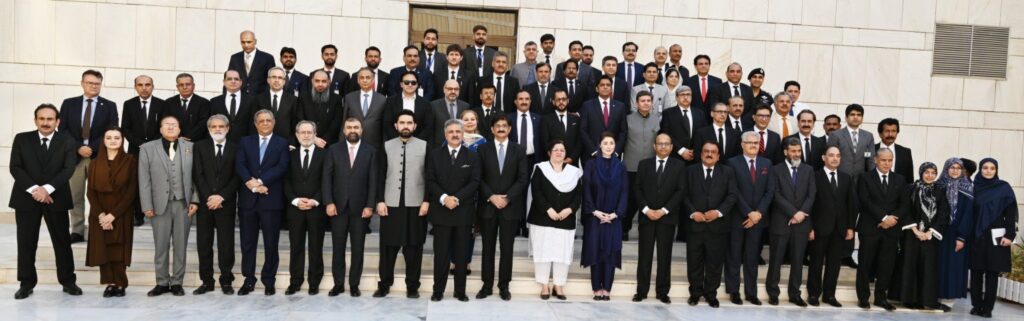
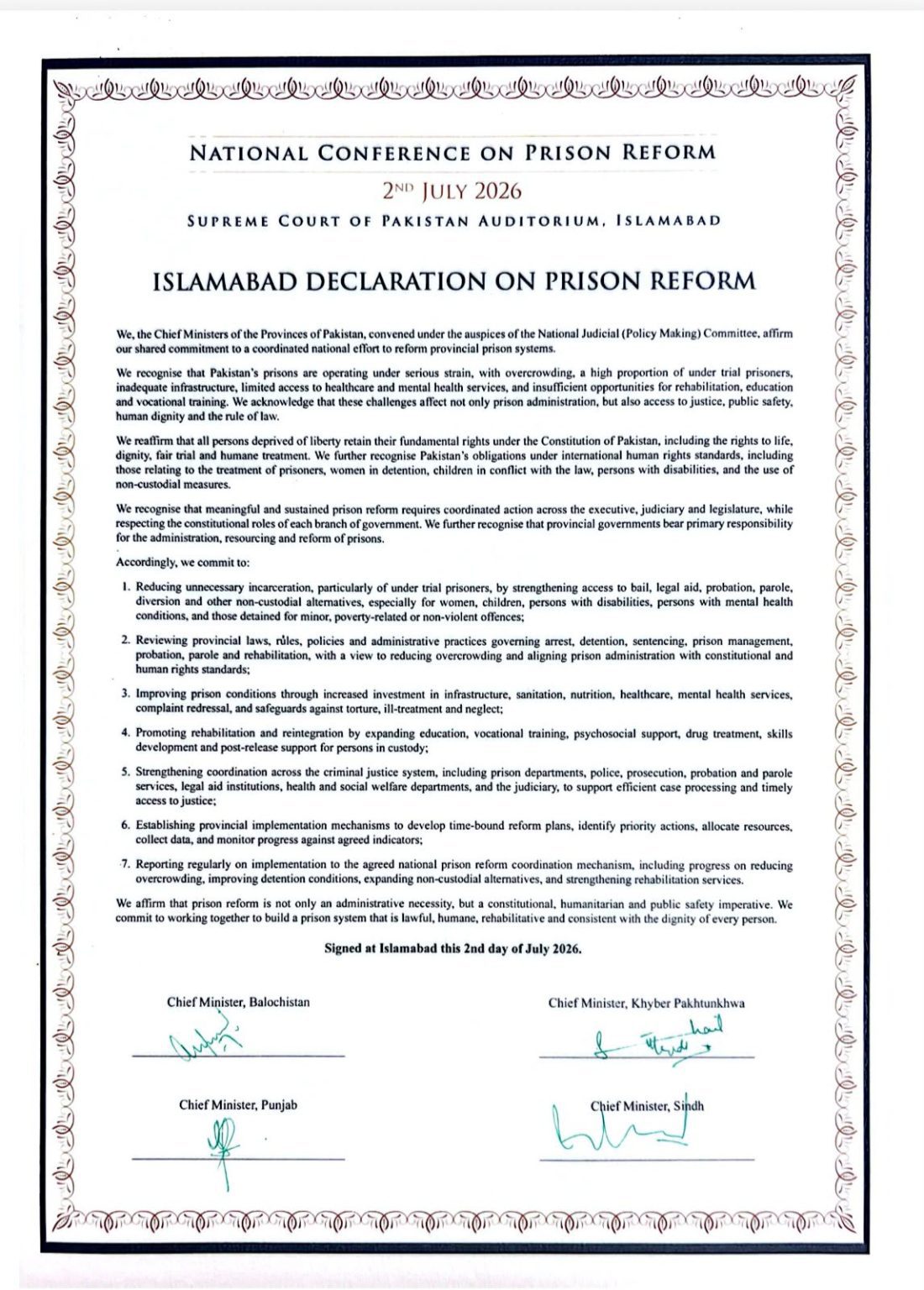
The Chief Ministers of Punjab, Sindh, Khyber Pakhtunkhwa, and Balochistan signed the Islamabad Declaration on Prison Reform at the conclusion of the National Conference on Prison Reform held at the Supreme Court of Pakistan. Convened under the auspices of the National Judicial (Policy Making) Committee (NJPMC), the conference brought together judicial leaders, provincial governments, legislators, and other stakeholders to reaffirm a collective commitment to strengthening Pakistan’s prison system.
Addressing the conference, the Chief Justice of Pakistan observed that shortcomings across the criminal justice system eventually manifest in prisons and stressed that every institution involved in the administration of justice shares responsibility for safeguarding human dignity and the rights of those deprived of liberty. He also highlighted concerns over delays in criminal trials and the ineffective functioning of prison grievance-redress mechanisms.
The Chief Justice informed participants that the NJPMC had constituted three-member committees in each province, comprising treasury and opposition parliamentarians with firsthand prison experience, assisted by legal coordinators, to examine prison conditions and identify systemic issues. Their recommendations were submitted to the NJPMC and shared with the respective provincial governments for consideration.
Through the Islamabad Declaration, the four provincial chief ministers reaffirmed their commitment to pursuing coordinated prison reforms, improving prison administration, reducing overcrowding, strengthening rehabilitation and reintegration measures, and ensuring that prison systems operate in accordance with constitutional guarantees, human dignity, and the rule of law. The declaration underscores a shared resolve to continue implementing reforms through cooperation between the executive, judiciary, and legislature.
