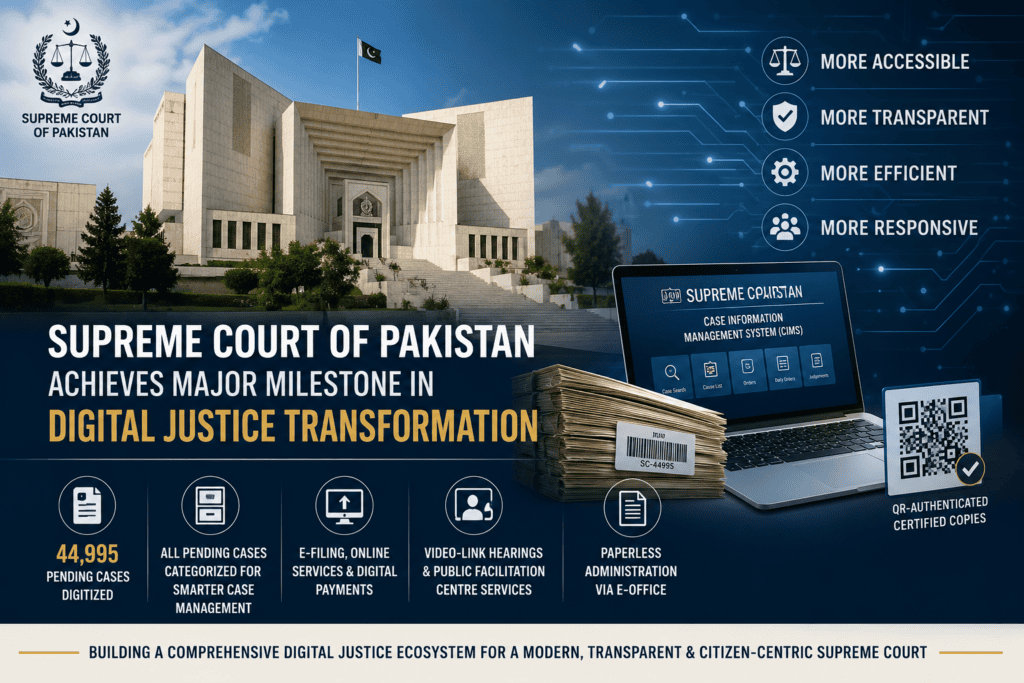
The Supreme Court of Pakistan has completed the digitization of all pending case records, marking a significant milestone in its ongoing institutional modernization programme aimed at establishing a comprehensive digital justice ecosystem. The initiative is part of a broader effort to enhance judicial efficiency, transparency, accessibility, and public service delivery through the integration of technology across the Court’s judicial and administrative functions.
According to the Supreme Court, a total of **44,995 pending case files** have been scanned in searchable OCR format, barcoded, digitally catalogued, and integrated into the Court’s Case Information Management System (CIMS). During the digitization process, the Court continued its regular judicial work, disposing of **11,999 digitized cases**, demonstrating the successful incorporation of digital systems into its day-to-day operations.
The Court has also, for the first time in its history, completed the categorization of all pending cases under a structured framework developed by a committee of Hon’ble Judges. Supported by a dedicated Categorization Cell, each pending case has been classified according to its jurisdiction and subject matter, laying the foundation for improved case management, efficient scheduling, priority-based allocation of judicial resources, and data-driven planning.
As part of its wider digital transformation, the Supreme Court has introduced several technology-enabled services, including e-filing of cases, QR-authenticated certified copies, online applications for judicial services, digital enrolment of advocates, electronic payment of court fees through OneLink and the State Bank of Pakistan, institutionalized video-link hearings, and a Public Facilitation Centre providing 35 citizen-centric digital services through an integrated online platform. Administrative operations have also transitioned to the Government’s e-Office platform, enabling paperless processing and strengthening transparency, accountability, and institutional efficiency. The Court reaffirmed its commitment to leveraging technology to modernize judicial administration while upholding the constitutional principles of fairness, transparency, due process, and judicial independence.
