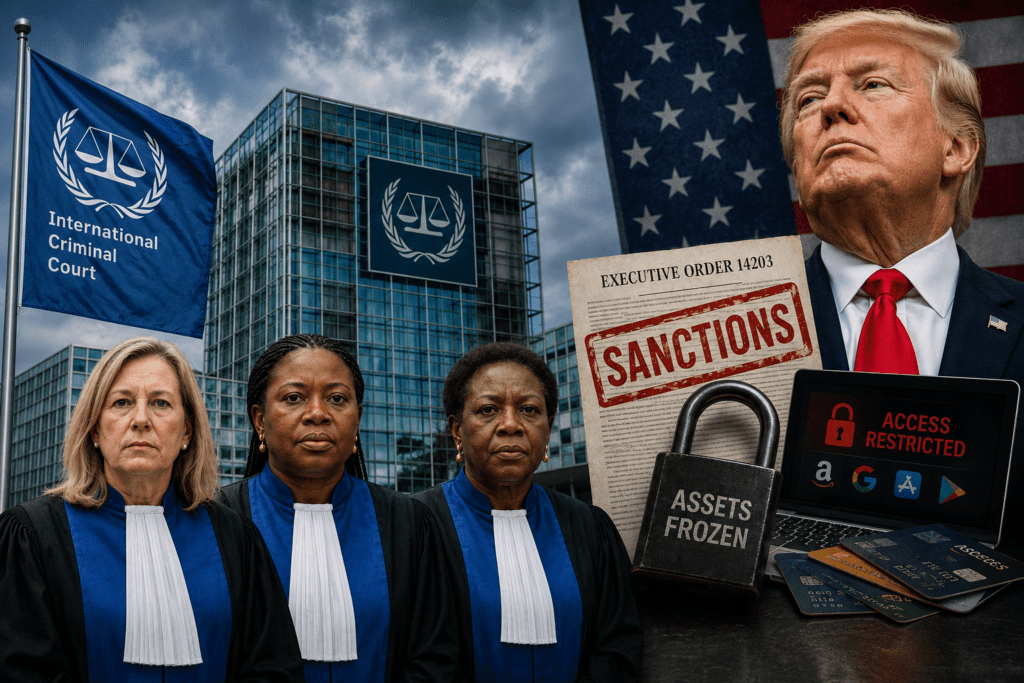
In an unprecedented legal move, three sitting judges of the International Criminal Court (ICC) have filed a lawsuit against President Donald Trump and senior members of his administration, challenging the legality of sweeping sanctions imposed on them .
The complaint was filed on Wednesday in the U.S. District Court for the Southern District of New York by Judges Kimberly Prost (Canada), Solomy Balungi Bossa (Uganda), and Reine Alapini-Gansou (Benin) . A summons was issued by the court on Thursday, requiring the government to respond within 60 days . The case names President Trump as the lead defendant, alongside Secretary of State Marco Rubio, Treasury Secretary Scott Bessent, and Acting Attorney General Todd Blanche .
This marks the first time ICC judges have personally challenged their designation under Executive Order 14203, signed by President Trump on February 6, 2025 . The order declared a national emergency over the court’s investigations into U.S. and Israeli nationals and authorized asset freezes and travel restrictions against foreign officials who participate in or support them .
The three judges are among eight on the court who have been sanctioned, alongside ICC Prosecutor Karim Khan, his two deputies, the UN Special Rapporteur for the occupied Palestinian territories, and three Palestinian human rights organizations . Each judge has served on panels investigating alleged crimes in Afghanistan or Palestine .
The “Financial Death Penalty”
The lawsuit argues that the sanctions go far beyond diplomatic measures, describing them as “tantamount to the financial death penalty” . According to the complaint, the judges have had assets frozen, credit cards blocked, and access to banking services and online platforms (including Amazon and Google) severely restricted . Judge Prost has reportedly lost access to health insurance after her provider refused to cover her . Judge Alapini-Gansou claims she can no longer use her credit card for basic expenses and fears for her safety when walking to the court .
Legal Arguments
The plaintiffs argue the sanctions are unlawful on three main grounds :
1. Exceeds Executive Authority: The order violates the International Emergency Economic Powers Act (IEEPA) and conflicts with the American Service-Members’ Protection Act (ASPA), which limits presidential responses to ICC actions .
2. Violates Due Process: Freezing the U.S.-based assets of Prost and Bossa deprives them of property without due process, in violation of the Fifth Amendment .
3. Arbitrary and Capricious: The designations violate the Administrative Procedure Act because the administration failed to produce specific evidence justifying them .
“The sanctions seek to compel these judges to refrain from their sworn oath, to decide cases on the basis of an impartial assessment of the facts and the law,” said James A. Goldston, executive director of the Open Society Justice Initiative and co-counsel for Prost . “That is a fundamental threat to the rule of law” .
This lawsuit is the fifth to challenge Executive Order 14203. In four earlier suits, courts found the order unconstitutional for imposing restrictions on the free speech of those assisting the court . This case directly challenges the judges’ designations .
