
Islamabad, March 2026 — The Majlis-e-Shoora (Parliament) has passed the Code of Criminal Procedure (Amendment) Act, 2024, introducing significant reforms to the law governing sureties, bail bonds, and penalty recovery in the Islamabad Capital Territory.
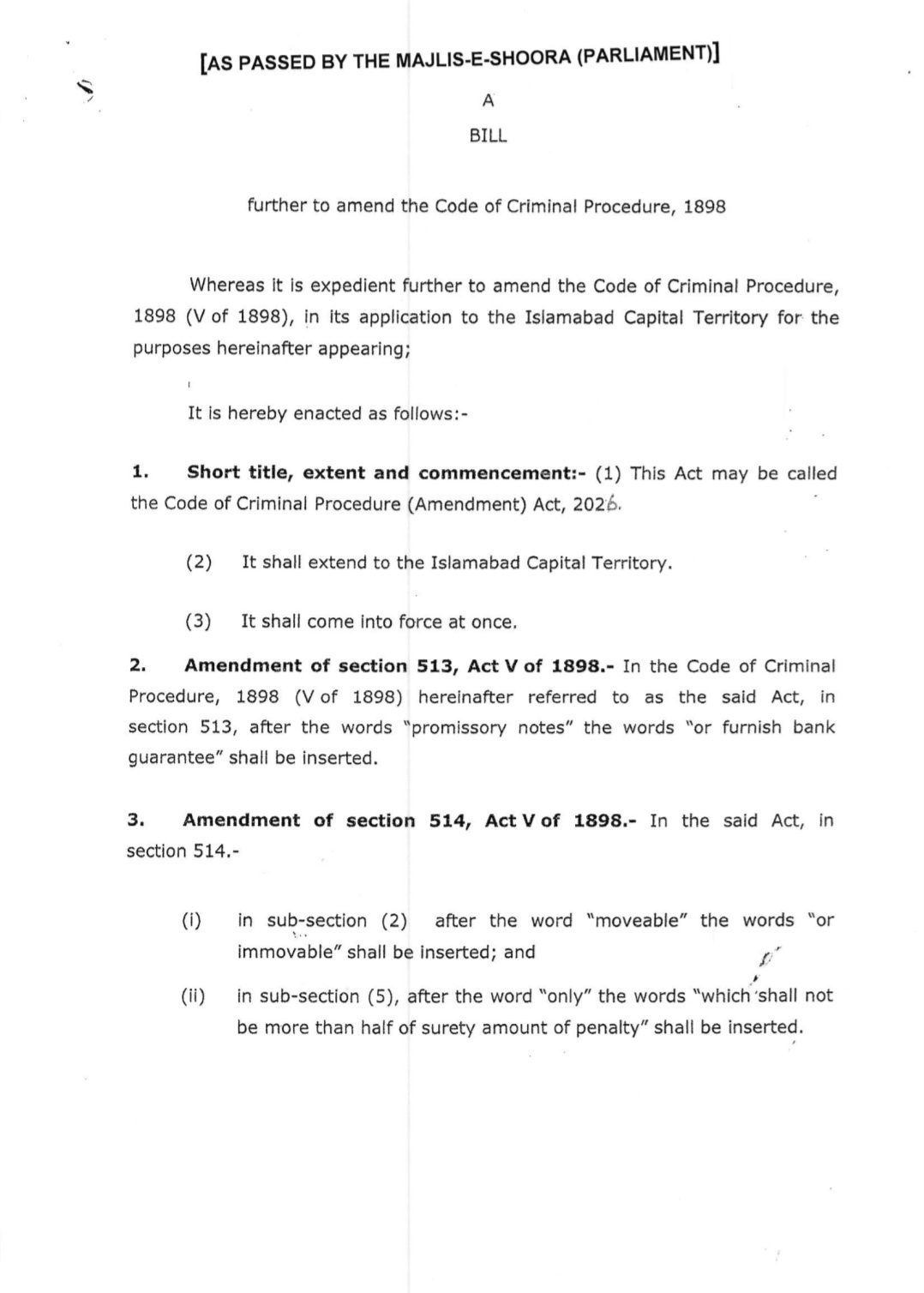
The amendment modifies Sections 513 and 514 of the Code of Criminal Procedure, 1898 (CrPC), modernizing Pakistan’s bail and surety framework by allowing bank guarantees, expanding the category of attachable property, and limiting excessive penalty recovery from sureties.
Section 513 (Amended Text)
“513. Power to take promissory note or furnish bank guarantee:
When any person is required to execute a bond with or without sureties, the Court may permit him to give a promissory note or furnish bank guarantee as sufficient security.”
(New words added: “or furnish bank guarantee”)
Section 514 (Amended Text)
(Relevant portions with amendments inserted)
“514. Procedure on forfeiture of bond.
(2) If a penalty is not paid, it shall be recovered as if it were a fine by attachment and sale of any moveable or immovable property belonging to such surety.
(New words inserted: “or immovable”)
(5) The Court may remit any portion of the penalty, but only which shall not be more than half of surety amount of penalty.”
(New words inserted: “which shall not be more than half of surety amount of penalty”)
These reforms carry significant impact for Islamabad’s criminal justice framework. By recognizing bank guarantees, the law becomes more aligned with modern financial practices, offering courts a more secure and verifiable form of assurance. The inclusion of immovable property in penalty recovery enhances the effectiveness of the surety system and reduces the risk of accused persons absconding. Meanwhile, capping the maximum penalty at half the surety amount provides a safeguard against harsh or excessive financial orders, encouraging more people to act as sureties without fear of crippling consequences.
Before this amendment, courts only accepted promissory notes or personal surety bonds, limiting flexibility; recovery for forfeited bonds could be made only from moveable property; and courts had wide, often unchecked discretion in imposing full penalties on sureties. These limitations frequently resulted in inadequate enforcement and significant financial hardship. The new law resolves these issues, offering a balanced approach that strengthens compliance while protecting ordinary citizens who support accused persons during criminal proceedings.
