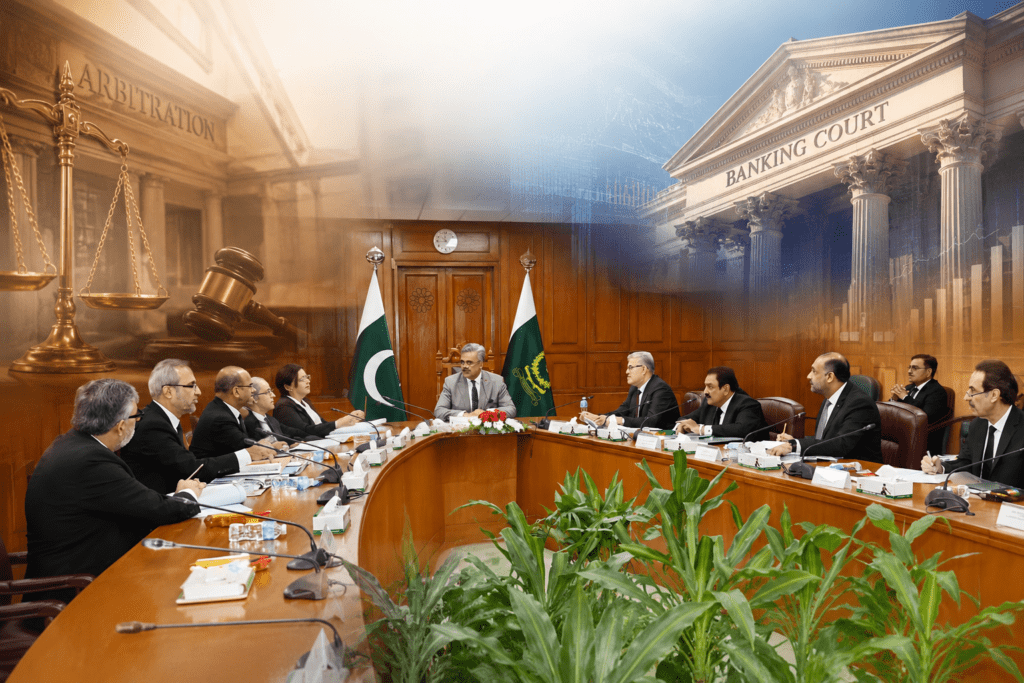
In a move aimed at reducing the growing burden of banking litigation and accelerating the recovery of financial claims, the Law and Justice Commission of Pakistan (LJCP), chaired by the Hon’ble Chief Justice of Pakistan, has approved the proposed insertion of Section 10A into the Financial Institutions (Recovery of Finances) Ordinance, 2001, introducing a formal Alternative Dispute Resolution (ADR) framework for banking disputes.
The proposed amendment seeks to provide banks, financial institutions, and borrowers with an alternative avenue for resolving disputes outside prolonged court proceedings. Under the proposed Section 10A, specialized ADR Committees comprising individuals with expertise in law, banking, and commerce would facilitate negotiated settlements between parties. The initiative is intended to encourage amicable dispute resolution, reduce litigation costs, expedite the recovery of outstanding finances, and ease the burden on courts dealing with banking matters.
If enacted by the Federal Government, the new framework is expected to transform the manner in which banking disputes are handled in Pakistan. Instead of immediately resorting to lengthy litigation, parties would have an opportunity to pursue structured negotiations before qualified experts capable of addressing both legal and commercial concerns. Legal experts believe the mechanism could significantly improve recovery rates for financial institutions while providing borrowers with a faster and less adversarial process for resolving disputes.
The proposal is currently at the recommendation stage and will become operational only after the Federal Government considers and formally adopts the amendment to the Ordinance. Upon implementation, ADR Committees are expected to function as specialized forums designed to facilitate settlements, thereby promoting commercial certainty and enhancing confidence in Pakistan’s financial dispute resolution system.
The decision was taken during the 48th meeting of the Law and Justice Commission of Pakistan held at the Supreme Court of Pakistan. The meeting was presided over by the Hon’ble Chief Justice of Pakistan in his capacity as Chairman of the Commission and attended by the Hon’ble Chief Justices of the Lahore High Court, Sindh High Court, Peshawar High Court, and Balochistan High Court, as well as Hon’ble Mr. Justice Arbab Muhammad Tahir of the Islamabad High Court, representatives of the Ministry of Law and Justice, members of Parliament, and senior members of the legal profession.
The Commission’s approval followed extensive consultations held on 30 April 2026 with key stakeholders, including representatives of the Ministry of Finance, State Bank of Pakistan, Pakistan Banks Association, Banking Mohtasib, Bar Associations, business organizations, and other relevant institutions. Participants emphasized the need for a modern dispute resolution framework capable of reducing delays in banking litigation while ensuring efficient recovery of finances and maintaining commercial stability.
Besides approving the proposed Section 10A, the Commission reviewed several major law reform initiatives, including amendments to the Code of Criminal Procedure, 1898, family laws, the Specific Relief Act, 1877, procedural rules relating to e-filing of cases, provisions of the Insolvency Act, 1920, and reforms aimed at improving access to justice for indigent litigants. The discussions reflected the Commission’s broader effort to modernize Pakistan’s legal system through legislative reforms, improved case management practices, technological integration, and greater reliance on alternative dispute resolution mechanisms.
The proposed banking ADR framework represents another step toward creating a more efficient justice system, reducing court delays, and strengthening investor and public confidence in the country’s legal and financial institutions.
