
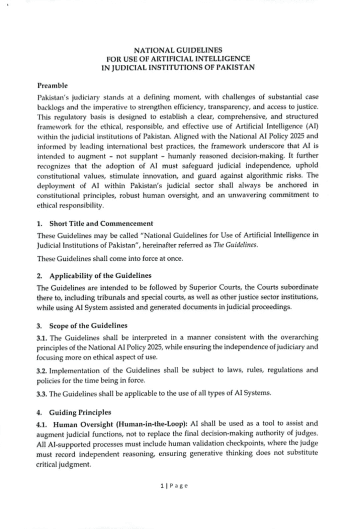
Pakistan has introduced the “National Guidelines for Use of Artificial Intelligence in Judicial Institutions of Pakistan,” marking the country’s first formal and comprehensive regulatory framework dedicated specifically to the use of AI within the judicial sector. Announced at a time when Pakistan’s courts are grappling with widespread case backlogs and demands for greater efficiency and transparency, these guidelines aim to modernize judicial processes while firmly safeguarding constitutional principles, judicial independence, and ethical responsibility.
The document makes it clear that the guidelines are tailored exclusively for judicial institutions and must be followed by the Superior Courts, subordinate courts, tribunals, special courts, and related justice-sector bodies when using AI-assisted or AI-generated documents in judicial proceedings. This is the first official acknowledgment by the judiciary that AI-generated material may appear in petitions, submissions, and court documents, but such use is heavily regulated. The guidelines emphasize that AI’s role is strictly supportive. The human judge will always remain the sole authority in making judicial decisions, and AI tools may never replace or overshadow human reasoning. One of the strongest statements in the guidelines stresses that human oversight is mandatory at every stage, ensuring “generative thinking does not substitute critical judgment,” reaffirming that judicial autonomy cannot be compromised by automated systems.
The framework is rooted in constitutional protections and must be interpreted in harmony with the National AI Policy 2025. It upholds ethical use, transparency, and independence of the judiciary, while acknowledging global best practices. The guidelines apply to all forms of AI, from basic automation tools to advanced generative AI systems, and their implementation is subject to existing laws, regulations, and policies.
A significant portion of the guidelines focuses on preventing algorithmic bias and ensuring transparency in AI-generated content. It mandates that any user—whether a judge, court staff member, or lawyer—must clearly identify which sections of a document were generated with the assistance of AI and must be able to explain how the information was verified. A standardized reporting system is promised to ensure traceability, avoid plagiarism, and maintain accountability. However, the guidelines do not specify how algorithmic bias will be practically prevented or audited, despite stating that AI systems used in the judiciary must be transparent and free from data bias. Considering that most AI systems operate on complex algorithms not open to public inspection, this omission leaves a significant unanswered question on enforcement and oversight.
The guidelines also underscore obligations related to privacy and data protection, requiring that confidential legal information and personal data of litigants, witnesses, and parties be safeguarded against unauthorized access or disclosure. Yet, the document stops short of explaining how privacy can realistically be maintained when many AI tools “learn” from user inputs. AI systems—especially generative AI—can store patterns and produce similar outputs for other users, posing a notable risk to confidentiality. The guidelines require privacy but do not clarify the mechanisms by which sensitive legal content will be prevented from entering the training data or memory patterns of AI systems, creating a substantial gap in practical data protection safeguards.
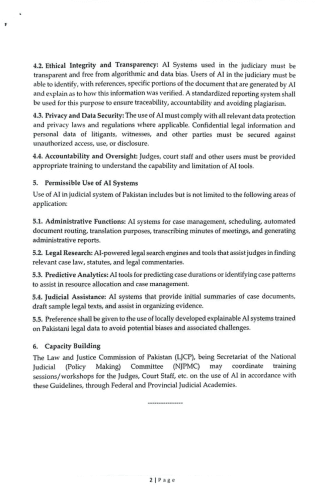
Despite these concerns, the guidelines outline several permissible uses of AI in the judiciary. AI may support administrative functions such as case management, scheduling, document routing, translation, transcription, and preparation of reports. It can be used for legal research by helping judges locate relevant case law, statutes, and commentaries. Predictive analytics may assist in estimating case duration and identifying judicial patterns for better resource allocation. AI tools may provide initial summaries of case documents, draft sample texts, and help organize evidence. The guidelines strongly encourage the use of locally developed, explainable AI systems trained specifically on Pakistani legal datasets to minimize cultural bias and dependency on foreign AI models.
Capacity building forms an important part of the framework. The Law and Justice Commission of Pakistan (LJCP), acting as the Secretariat of the National Judicial (Policy Making) Committee (NJPMC), may coordinate training programs, workshops, and sessions for judges and court staff across federal and provincial judicial academies to ensure that users understand both the capabilities and the limitations of AI tools before relying on them.
Overall, while the guidelines represent a significant step toward technological advancement in Pakistan’s judiciary and demonstrate a balanced approach between innovation and judicial autonomy, they also raise critical questions. The absence of mechanisms for auditing algorithmic transparency, preventing the misuse of sensitive data, and ensuring that AI systems do not retain or reproduce confidential legal information leaves important privacy and security concerns unresolved. Nevertheless, the National Guidelines mark a transformative and forward-looking development, reaffirming that technology may assist—but never replace—the human judge who remains at the center of Pakistan’s judicial process.
