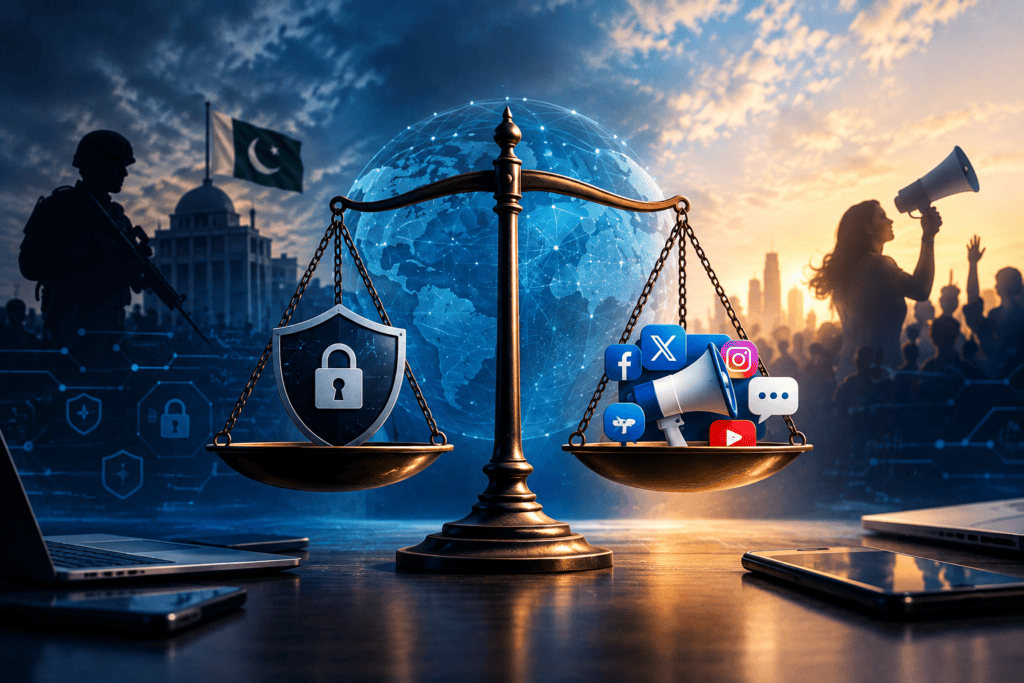
The digital revolution has radically transformed how citizens communicate, organize, and express themselves. In democratic societies, digital platforms serve as the modern town square, offering unprecedented avenues for free speech, political critique, and citizen journalism. However, this borderless digital expansion has also introduced novel threats to state sovereignty, public order, and national security. In Pakistan, the resulting friction between individual constitutional liberties and the state’s duty to protect its borders, both physical and digital, presents one of the most critical legal dilemmas of the 21st century.
The Constitutional Matrix: Liberty vs. Restriction
To understand this conflict, one must look at the constitutional architecture of Pakistan. Freedom of speech is not absolute; it operates within a carefully calibrated legal framework. Article 19 of the 1973 Constitution of Pakistan guarantees every citizen the right to freedom of speech and expression, as well as freedom of the press. However, this right is explicitly subject to “reasonable restrictions” imposed by law in the interest of:
- The glory of Islam
- The integrity, security,
- or defense of Pakistan Friendly relations with foreign states Public order, decency,
- Morality Contempt of Court or incitement to an offense.
The Digital Paradox While Article 19 provides the ground rules, the definition of what constitutes a threat to “national security” or “public order” has become increasingly fluid in cyberspace. In the digital age, a single viral post can spark localized violence or destabilize financial markets, causing states to favor preemptive control over retroactive legal action. The digital age shattered this predicating. The explosion of social media platforms means that millions of citizens can instantly broadcast unfiltered thoughts to a global audience. This democratization of speech has blurred the lines between legitimate dissent, investigative journalism, and activities that could genuinely comprise state security or incite public order.
International frameworks safeguarding Civil Liberties
The international covenant on civil and political rights (ICCPR, 19SIX),
A legally binding treaty that explicitly guarantees civil liberties. To protect citizens from overreach, international bodies and legal networks rely on foundation human instruments to challenge domestic security overreach;
The Universal Declaration Of Human Rights (UDHR)
- ARTICLE 12 RIGHT TO PRIVACY
- ARTICLE 19 FREEDOM OF EXPRESSION
Legal frame work PECA 2016
Legal frame works and the expansion of state power to address these emerging digital challenges, the state enacted the prevention of Electronic Crimes Act (PECA) in 2016. While designed to combat legitimate cybercrimes like identify theft, financial fraud, and cyber terrorism, PECA has become the epicenter of the free speech debate. Section of law most notably section 20, which criminalizes the online transmission of false information that harms reputation or privacy have faced intense security. Critics and human rights advocates argue that terms like ‘’glory of islam’’ or ‘’security of Pakistan’’ are applied too broadly within digital context. The expensive interpretation allows regulatory bodies like the Pakistan telecommunication Authority (PTA) and enforcement agencies like the Federal Investigation Agency(FIA) to crack down not just on security threats, but on political critique, investigative reporting, and civilian dissent. The introduction of supplementary regulations, such as the ‘’removal and blocking of unlawful online content rules’’, has further centralized the state’s power to police the internet. These rules compel social media companies to remove content or risk heavy penalties, creating systematic environment of censorship.
The role of judicial supervision in digital age.
Judicial oversight serves as the primary constitutional mechanism to check executive authority, protecting civil liberties from state overreach under the guise of nation security. In the digital ecosystem, independent judiciaries may responsible for ensuring that state surveillance, internet regulations, and content takedown demands adhere to constitutional protections and international human rights standards.
┌───── Independent Courts │ │ (Warrants, Judicial Reviews) ─────────────────────────│ └──────────────┬───────────────┘ │ ┌───────────────────────┴───────────────────────┐ ▼ ▼ ┌─────────────────┐ ┌─────────────────┐ │ State Agencies │◄───────────────────────────►│ Tech Platforms │ │(Threat Tracking)│ Coordinated Compliance │(Content Moderation)
CONCLUSION
The conflict between national security and freedom of expression in digital age represents a defining constitutional and human rights challenge of the twenty-first century. The internet has transformed from a decentralized haven for free speech into a highly contested geopolitical battleground where state sovereignty may collide with individual liberties.
