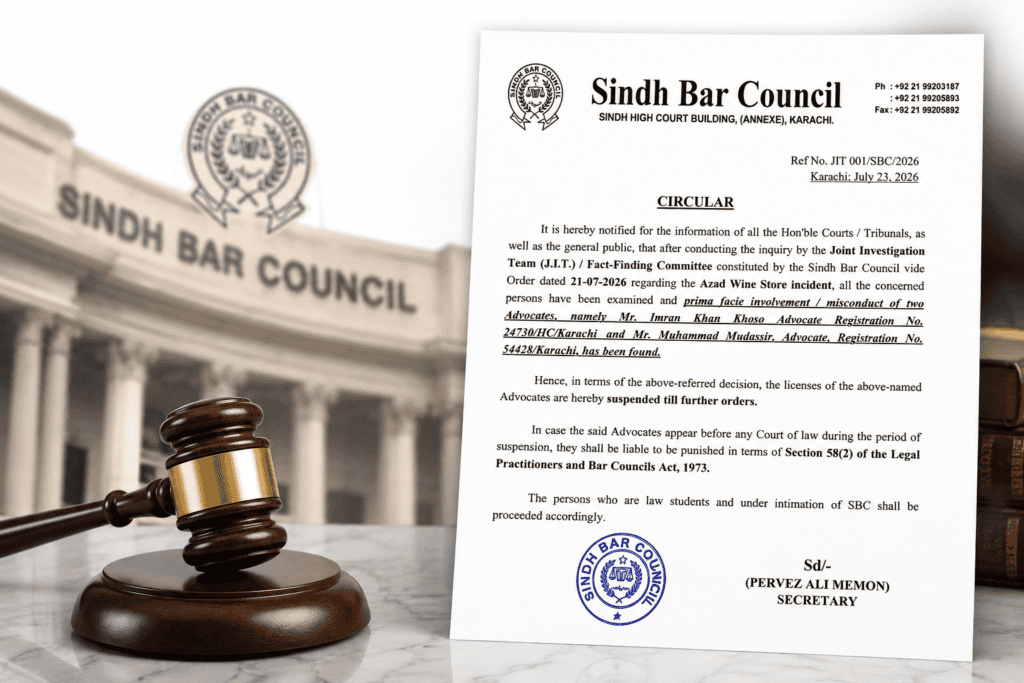
KARACHI, July 23: The Sindh Bar Council (SBC) has suspended the licences of two advocates after a Joint Investigation Team (JIT)/Fact-Finding Committee found prima facie evidence of their involvement in the Azad Wine Store incident. In a circular issued on Thursday, the Council stated that the inquiry committee, constituted through an order dated July 21, 2026, completed its investigation and found prima facie misconduct against Advocate Imran Khan Khoso (Registration No. 24730/HC/Karachi) and Advocate Muhammad Mudassir (Registration No. 54428/Karachi). Acting on the committee’s findings, the SBC suspended their licences with immediate effect until further orders and warned that any appearance before a court during the suspension period would attract action under Section 58(2) of the Legal Practitioners and Bar Councils Act, 1973.
The action stems from the widely publicised Azad Wine Store incident in Karachi, where videos circulating on social media allegedly showed a group of individuals, including practising lawyers and law students, entering the premises of the licensed liquor outlet and engaging in disorderly conduct. The footage triggered strong public criticism and prompted the Sindh Bar Council to take suo motu notice of the matter. On July 21, the Council constituted a Joint Investigation Team/Fact-Finding Committee to independently examine the allegations, identify those involved and determine whether members of the legal profession had violated professional ethics and disciplinary standards. ([High Court of Sindh][1])
According to the SBC circular, the committee examined the available material, including video evidence and the identities of the persons present during the incident, before concluding that prima facie involvement and professional misconduct had been established against the two advocates. The Council further stated that individuals involved in the incident who are law students will also face proceedings in accordance with the applicable rules. The disciplinary action reflects the Council’s position that misconduct by members of the legal profession, particularly in incidents attracting public attention, will be dealt with through formal disciplinary mechanisms pending the completion of further proceedings.
