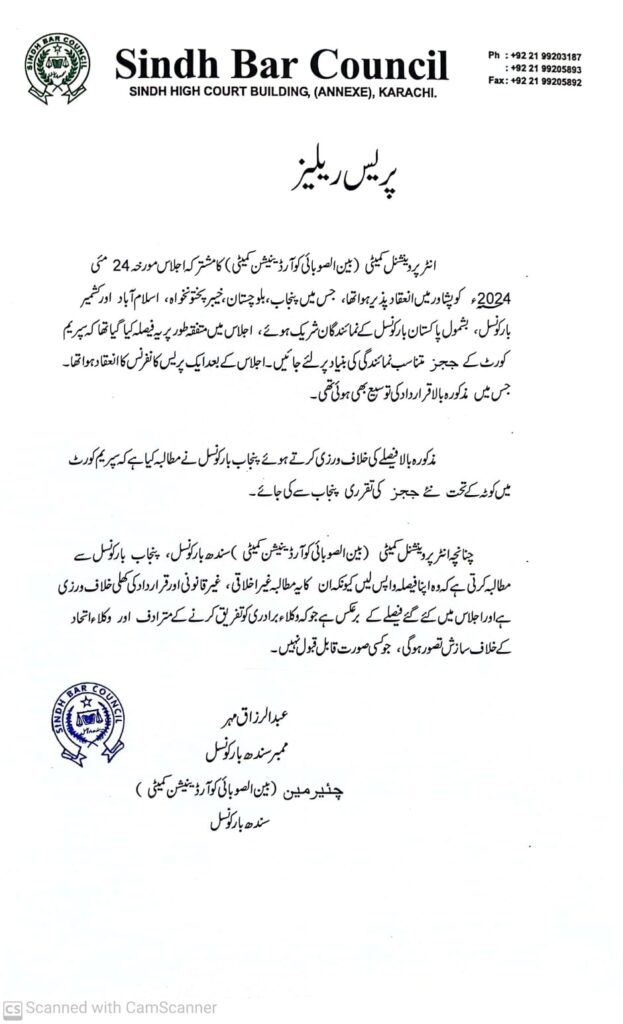
The Sindh Bar Council has issued a strong condemnation against the Punjab Bar Council for its recent emphasis on a quota system for appointing judges to the Supreme Court. In a press release, the Sindh Bar Council expressed its disapproval, labeling the demand as illegal, unethical, and detrimental to the unity of the legal fraternity.
The controversy stems from a meeting of the Inter-Provincial Committee Assembly held on May 24, 2024, in Peshawar, where representatives from all provincial bar councils were present. During the session, it was unanimously agreed that the appointment of judges should be based solely on merit. The session concluded with a press conference, during which the consensus on merit-based appointments was publicly affirmed.
Despite the collective agreement, the Sindh Bar Council was taken aback when the Punjab Bar Council subsequently deviated from the settled consensus, advocating instead for a quota system that would ensure the appointment of judges from Punjab. The Sindh Bar Council has denounced this stance, arguing that it undermines the principles of meritocracy and equality within the judiciary.
In their press release, the Sindh Bar Council stated, “The demand for a quota system by the Punjab Bar Council is not only illegal and unethical but also poses a significant threat to the unity and cohesion of the legal community. Such divisive measures are completely unacceptable and go against the spirit of our profession.”
The Sindh Bar Council emphasized the importance of maintaining a unified front and ensuring that judicial appointments are free from provincial biases. They reiterated their commitment to upholding the principles of merit and integrity within the legal system.
The Sindh Bar Council’s condemnation has sparked a debate within the legal community, highlighting the ongoing tensions between regional representation and merit-based appointments. The response from the Punjab Bar Council and other provincial councils is yet to be seen, but the Sindh Bar Council remains steadfast in its position against the implementation of a quota system.
This development underscores the need for continued dialogue and cooperation among provincial bar councils to ensure that the judiciary remains independent, fair, and representative of the highest legal standards. The Sindh Bar Council’s stance serves as a reminder of the importance of unity and meritocracy in preserving the integrity of the judicial system.
